Sunday, June 27, 2010

Sails


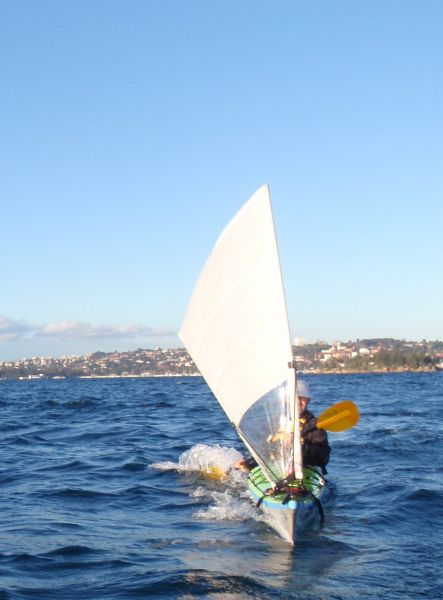
The only thing better than a sail is ...

... two sails.


See ya!

Friday, June 25, 2010

Abalone pearl

At a location somewhere along the east Australian coastline (only accessible by nimble kayak) Tony spots an abalone with a rather nice surprise inside ... 

How about that?!.

Sunday, June 20, 2010

Mid-winter

The almost winter-solstice sun rising at the base of North Head.


The Pacific Ocean being true to name on this sunny morning.

Peter sailing towards the ledge of North Head.

Monday, June 14, 2010

Branches

Sydney from 20,000 feet. Copyright David Moore

In recent times we've been paddling beneath the sheer cliffs along the coastline outside the Sydney Heads. This morning's journey, by contrast, turned inwards to travel up one limb of Sydney's branching waterways.
 Sailing towards Middle Head.
The distinctive conveyor belt of offshore clouds still forming over the remains of the East Australian Current.


 Turning westward to paddle up Middle Harbour and into the clear blue winter skies of the interior ...


Sydney Red Gum (Angophora costata) thriving on the thin soils of the sandstone peninsulas.

 
A flooded forest west of Roseville Bridge.


Cloud wisps forming on the river's surface.


As Sydney as it gets ...


In a world that is widely corrupted by insensitive and misplaced human endeavour it is fortunate to have this land and waterscape at our paddling fingertips.

Sunday, May 30, 2010

Farewell to Autumn


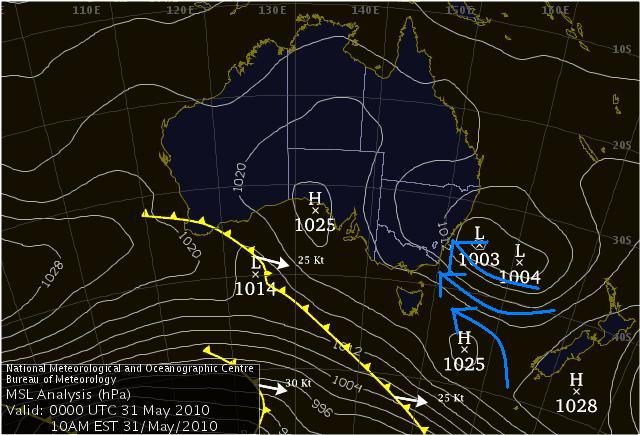
The low and high pressure air cells presently rotating over the Tasman Sea are operating like a pair of giant cog wheels to channel a stream of moist air on to the east coast.
As well as lifting moisture into the atmosphere this onshore wind is pumping up the sea swell.
 
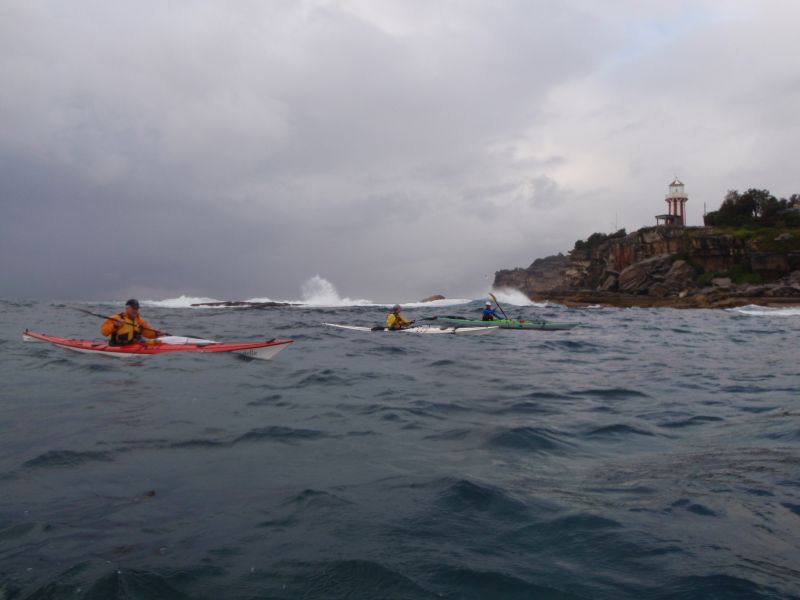
  Dawn at the Heads. 


 South Reef.
  
 
 Derek casually sailing over the shoulder of an emerald tube peeling out of the Tasman Sea.


 When the eroded section of cliff at "The Gap" finally breaks through between the sea and the harbour (in about 66,000 years by rough guess-timation), South Head will be an island not unlike Bowen Island at the south head of Jervis Bay.

 
Back in the harbour and exploring the shoreline for crays.
(One seen but left for another day)

 
A week of solid late-autumn rain, sucked off the warm sea and deposited in-shore, finds its saturated way back into the harbour.

Monday, May 24, 2010

Water in motion

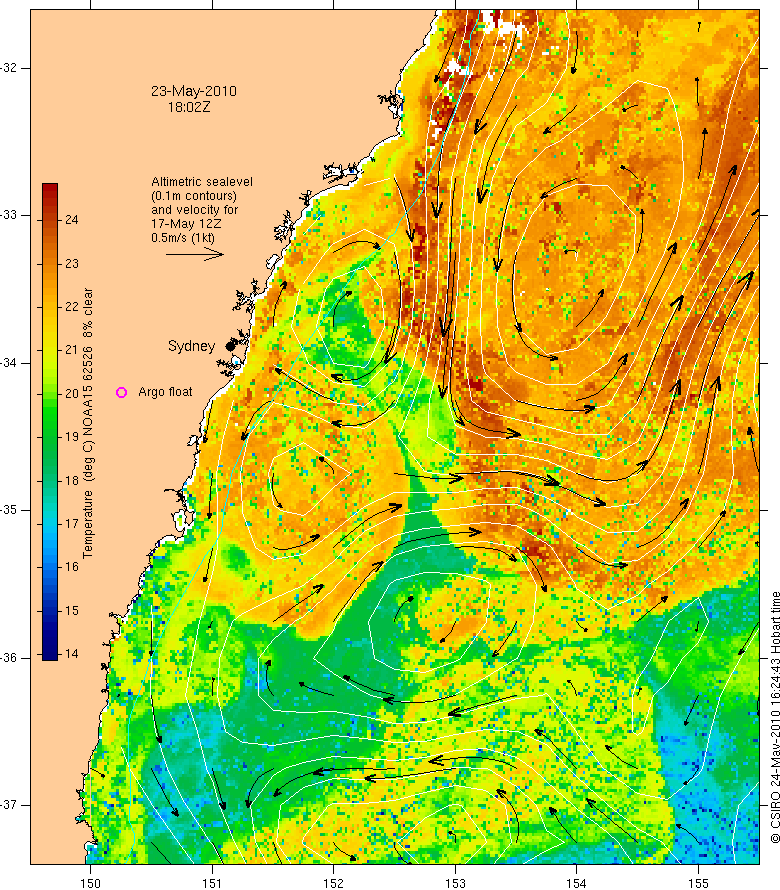
The CSIRO has published the following commentary on Sydney's sea surface temperature and currents:
May 18, 2010 - update on Sydney:
Beach water temperatures are still extremely high but the East Australian Current has now started to flow mostly away from the continental shelf at the latitude of Sydney, rather than towards the coast (as it has since late April), triggering the beginning of the end of the high temperatures.
The explanation is faily complex:
Between Sydney and Newcastle a clockwise-rotating, cold-core eddy has now become well established inshore of the EAC. Until the last few days, the EAC was flowing south around this cold-core eddy, feeding into a large pool of EAC water that is warmer than is normally seen off southern NSW at this time of year. The cold-core eddy has now grown so large that very little of the EAC is continuing south: most appears to be flowing offshore at the critical junction point at 34.5S, 152.5E. To complete this eddy-shedding process, the cold-core eddy off Newcastle is likely to merge with the larger cold-core eddy to the SE, thereby completely separating the two masses of warm EAC water: the parent body to the NE, and the newly-shed body to the south.
May 19, 2010 Update:
The eddy shedding is now complete.

Image from CSIRO

Paddling out through the Heads and into the last of the warm sea water for this season.

A Bonito tuna leaps aboard while, in the background, the saturated clouds of moisture forming over the "hot" sea current release some of their water back into the sea ...

... and onto the land.


At its edges the sea's motion is visible in crashing waves along the coastline. But it's the larger "un-seen" drama of massive tumbling vortexes of water moving around offshore that affects our local conditions so profoundly. With the conveyor belt of hot energy that is the EAC now declining in its capacity to push southward at the end of this year's annual cycle we will soon feel cold water on our paddling finger tips and soon see the stream of migrating whales, soaring albatross and curious seals of winter.
Sunday, May 16, 2010

Sydney cray

Previously we have observed that kayaking and snorkelling are complimentary arts of the sea.
This morning Derek and Tony find a spot accessible by nimble kayak where a dive beneath the surface reveals an exceptional Sunday lunch ...


Tony earns bonus domestic-leave-kayaking-rights from his happy wife with this excellent result.