Wednesday, January 26, 2011

La Niña


This morning the harbour and its outside coast line were obscurred by clouds of very moist air.
The typically golden sandstone of North Head was unfamiliar in this dark atmospheric cloak.
And the short journey around to Shelly Beach was accompanied by the feeling that we were paddling along a foreign coastline.

The large-scale physical condition that seems to be driving this localised humid atmosphere (and the significant rainfall experienced recently along much of the east coast of Australia) is the embodied heat energy of the sea water in the western Pacific. As the diagram below from the CSIRO describes, we have a La Niña event in full-blown occurence ... 


At least the Bonito seem to like the warmer water.


On the return journey to the harbour the clouds of moisture continued to tumble over the face of North Head like a slow-motion waterfall. (Peter's sail just visible on the left)

Click on the Sea Surface Temperature chart (to the right) to see the cell of hot water that is circulating east of Sydney at the moment.
NOTE - if you're reading this posting many days after 26th January 2011then the cell of hot water will have evolved along its merry way to be replaced by some other body of cooler or warmer water.

Wednesday, October 20, 2010

J-Bay

The tribe has just returned from 3 days of kayaking at Jervis Bay.


A full trip report is available at:


Sunday, September 12, 2010

King cray

Tony does it again with another Sunday dinner pulled from Sydney's coastline ...

Sunday, August 22, 2010

More local tucker

Kingfisher just back on shore with his winter lunch sourced from the Sydney coastline.

Look and you shall find.

Monday, August 16, 2010

Harbour tucker

To the impressive list of recent finds that Tony has hunted and gathered in Sydney Harbour is this live scallop.
Abalone, bonito, crays, kingfish, octopus, oysters, mussels, prawns, (Australian) salmon, sea urchins, tailor and now a plump Port Jackson scallop.

Self-sufficiency based on an affinity with the harbour's natural habitats is a fine characteristic that once under-pinned the indigenous clans of this harbour.

Sunday, July 25, 2010

The north passage

An early departure.
Time that is moved by little fidget wheels
Between the double and the single bell
Is not my time, the flood that does not flow.
 
A setting moon.
Deep and dissolving verticals of light
Ferry the falls of moonshine down.

Channel marker.
In the moon's drench, that straight enormous glaze,
And ships far off asleep, and Harbour-buoys
Tossing their fireballs wearily each to each
(Excerpts from Five Bells. Kenneth Slessor.)


This morning's passage from Felix Bay on the lower harbour to the upper-most capillaries of Middle Harbour was done mostly in complete and beautiful darkness.
The timing of the passage coinciding with the peak of this morning's flood tide.

The images above and below are taken at East Killara and North Forestville where the salty Pacific Ocean of the harbour blurs into increasingly brackish channels and finally a fresh water creek.

The three narrow channels branching off into the valleys of Killara and Forestville are tightly enclosed by the trunks and canopies of tall trees crowding down to the water's edge.

The sky traces the creek's path through the tree canopies.

At Carrol Creek, in the Garigal National Park, the watery track is interrupted by a rock staircase, small waterfalls and rills. A kayak portage is required to get up to the creek that lies wholly above the high-tide level. It is completely fresh.

Quietly paddling into this extraordinary tributary of Sydney Harbour.


Drifting into the last navigable metres of Middle Harbour accompanied by birdsong and the overhanging parasols of tree ferns. The air temperature was low - my finger tips an alarming blue.

Turning around, and with the sky now illuminated, the landscape that I had paddled through for almost three hours in the dark was revealed in all its transcendant beauty.


Of the hundreds of buildings that lined this morning's kayak route only one came even near responding successfully to its landscape context in a harmonious way. This house tucked into the western face of Seaforth shows a sensible hand at work in fracturing the building's form into two volumes and cladding the exterior in vertical boards of clear-treated hardwood. It's a low-key and sensitive solution to inserting a building into a distinctive landscape.

Sailing back into familiar territory ...

... and arriving home 6 hours and 45 minutes since leaving.
~~~

Sunday, June 27, 2010

Sails


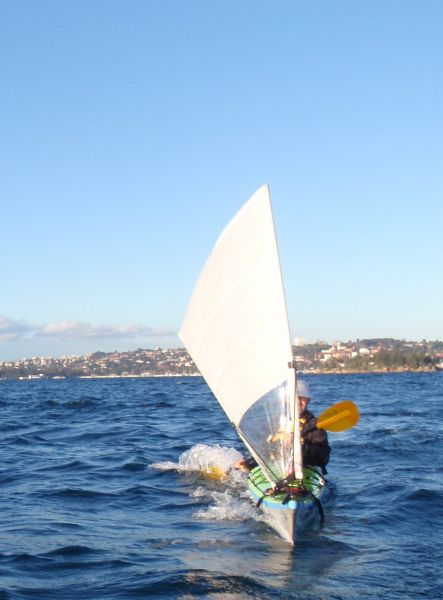
The only thing better than a sail is ...

... two sails.


See ya!

Friday, June 25, 2010

Abalone pearl

At a location somewhere along the east Australian coastline (only accessible by nimble kayak) Tony spots an abalone with a rather nice surprise inside ... 

How about that?!.

Sunday, June 20, 2010

Mid-winter

The almost winter-solstice sun rising at the base of North Head.


The Pacific Ocean being true to name on this sunny morning.

Peter sailing towards the ledge of North Head.

Monday, June 14, 2010

Branches

Sydney from 20,000 feet. Copyright David Moore

In recent times we've been paddling beneath the sheer cliffs along the coastline outside the Sydney Heads. This morning's journey, by contrast, turned inwards to travel up one limb of Sydney's branching waterways.
 Sailing towards Middle Head.
The distinctive conveyor belt of offshore clouds still forming over the remains of the East Australian Current.


 Turning westward to paddle up Middle Harbour and into the clear blue winter skies of the interior ...


Sydney Red Gum (Angophora costata) thriving on the thin soils of the sandstone peninsulas.

 
A flooded forest west of Roseville Bridge.