Sunday, August 26, 2012

End of winter ...


OK - yet another day on the water that seems worth sharing ...

Today the tribe was up early, paddling through ribbons of phosphorescence from as early as 4.50am and from various launching points before picking out each other's blinking night-lights and then travelling as a pod of four on a course for Barrenjoey and Pittwater.

It was a great feeling being offshore in such calm sea conditions and under a starry pre-dawn sky. A light westerly filled the bellies of our sails and made for easy paddling along a wide curving arc from North Head up to Avalon.


Somewhere east of Narrabeen.


Reverse paddling into a sea cave at Avalon Headland.


Tony jumps in to find dinner.


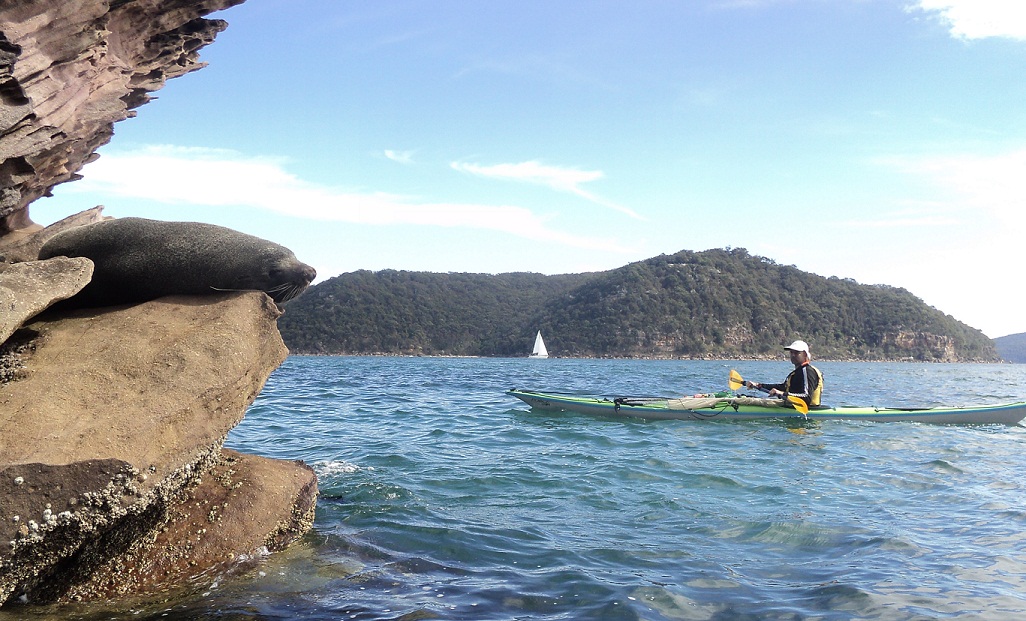
Rounding Barrenjoey a sun-baking seal barely raises a long eyelash at our arrival.

 
Well, a half-hearted yawn at least.

Another great day on the water with our kayaks ...


... as Tony's wife would agree.

Sunday, August 19, 2012

Abalone, crays and Humpback whales ...


OK ... so I wasn't intending on sharing the trivial details of our trip preparations but today's paddle along Sydney's northern coastline qualifies for special mention ...


A pair of Humpback whales travelling south.


And then, after a beautiful and productive dive into the clear winter water along Sydney's coastline, Tony conjures up this amazing abalone and crayfish risotto.

Quite a memorable day.

Wednesday, August 1, 2012

Over the horizon


The tribe is now focussing on 6 months of intensive kayaking in preparation for a return to the beautiful land and seascapes of Tasmania.


During this period of preparation there will not be further posting to this blog.

There are already enough scoundrels on the internet without our additional contributions.

See ya.

Sunday, July 15, 2012

Kayak sail


A photographic summary of the process of making a sail for the kayak can be found HERE.

Sunday, July 1, 2012

Winter ~ Pittwater

 A winter's sojourn to West Head, Pittwater.

Angophoras and xanthorrhoea.


Some other locals.


Perched on the eastern side of Pittwater is the Memory House designed by Walter Barda. 
Of the many buildings observed around Pittwater this morning this one alone generated a sophisticated dialogue with its use of local materials - Hawkesbury sandstone and finely worked native hardwoods - and with a humourous wink it incorporates local rock oyster shells into the stucco of an exterior wall ... see bottom left.

Sunday, June 24, 2012

Winter ~ along the Sydney cliffline


Sailing with a light westerly to North Head at dawn.

With one eye on building a new single-masted sail this is a continuing experiment with the behaviour of a couple of different rig designs, as referred to in the previous post. A double-masted V-sail and a slightly weather-beaten single-masted Tasmanian rig are being used in the photo above.


Having sailed to the base of North Head we re-set our course 180 degrees and managed to pick up a breeze to take us southwards along the cliffs. Above are the V-sails on Tony and Derek's kayaks. Not withstanding the findings expressed below on the limitations of the V-sail, this rig works well in light breezes - picking up every breath.of air and giving the kayaker a free knot or so of momentum.


Breakfast of ocean trout at a favourite cliff spot - only accessible by nimble kayak in slight seas. And then, with our kayaks perched on the rock platform, we snorkelled amongst crayfish crevices and into deep blue drop-offs along the cliff's edge.


A humpback whale singing its way north.

~~~~~~

Monday, June 11, 2012

Kayak sail

Just a limited observation on the historial precedents of sail design for modern sea kayaks ...

1. Observations of an Inuit's kayak sail:

- Single mast
- Single sail batten
- Single sail sheet
- No mast stays
- Sleeved / socketed mast housing
- Fairly low sail area, say 0.6 to 0.75 sqm
- Low centre of effort in the sail, say no higher than the paddler's eyeline
- Mast housed off centre-line of the kayak
- Mast step located well forward of typical paddle stroke
- Limitations on engaging the sail at sea (or at least I'm uncertain how the sail is engaged at sea. Presumably by a paddling partner)
- Sail and mast can be dis-engaged at sea by a deft flick of the paddle and retrieved by hauling in the sail sheet
- Sail is stored off the foredeck (presumably on the rear deck or within the cockpit).

 Above: Sailing by the Manitounuk Islands, 1927.
(L.T. Burwash. Public Archives of Canada)
Source - Inuit kayaks in Canada (1987) - E.Y. Arima


Above: Inuit sketch of kayak sail in elevation. (Same publication as above).


It is unclear whether this kayak sail has ancient origins or if it is a relatively late innovation based upon exposure to European and American sailing vessels.

The observations of this sail design include that the intent was to:

- keep the sail simple (one mast, one batten, one sheet),
- minimise the risk of overturning (low overall sail area with low centre of effort, and
- maintain a clear foredeck with the sail stored elsewhere when not operational.

The Inuit sail shown above is not too dis-similar in profile to many modern kayak sails.

However, unlike the Inuit kayak sail, modern kayak sails are typically stored in one of two ways: -

(i) folded down and lashed to the foredeck (where the sail is exposed to catching waves, accumulating water and impeding the paddler's performance); or
(ii) housed within a sleeve on the foredeck.


2. Observations of a Maori canoe sail:

- Double mast (V-shape sail)
- No sail battens
- Multiple sail sheets.
- Single forestay and twin side-stays
- Large sail area, say greater than 1.5 sqm
- High centre of effort in the sail, higher than the paddlers' eyeline
- Mast housed on centre-line of the canoe, but able to be inclined to leeward to allow spill.
- Mast step located forward of typical paddle strokes
- With an open cockpit the sail is simply engaged at sea by the forward paddler
- Sail can be disengaged by the forward paddler
- Sail is stored within the canoe's cockpit.


Above: Nouvelle Zélande - Pirogue du canal de l'Astrolabe.
Hand coloured engraving by De Sainson (1833)


The observations of this sail design include that the intent was to:


- maximise the opportunity to catch air movement above the paddlers' bodies (high centre of effort in sail) , and possibly
- be able to trim the sail setting by adjusting the angle of the leading mast edge (as in a windsurfer's sail).


The above Maori canoe sail is also not too dis-similar to some modern sail designs that are marketed for kayaks.


Summary from the above observations ...


The Inuit kayak sail is well suited to the low moment-resisting profile of a kayak. Its sail area is relatively small and contributes to topping up the hull speed of the down-wind journey of the kayaker.


The Maori canoe sail - or V-sail - with its high centre of effort, is not as well-suited to the low moment-resisting profile of a kayak. In a canoe the combined weight of the mutiple paddlers leaning out to windward can compensate for the over-turning effect of the V-sail - this is difficult to compensate for in a kayak with a single paddler. The V-sail is also prone to a yawl-effect when travelling directly downwind.
And when this type of V-sail is mounted onto the deck of a kayak it has a further disdvantage - the foot of the sail will generate a stalling effect on hull speed when the kayak's bow overtakes the wave infront and gets partially buried within the wave on its way through - which is often the case in steep seas. 

 
Obvious conclusion:
 
The smaller profile of the simply rigged Inuit kayak sail rig holds multiple benefits for the sea kayaker as compared with the V-sail design of the Maori canoe.


Other thoughts:


In designing a modern version of a sea kayak sail rig the designer would do well to arrive at a solution that;


(i) limits the use of multiple mast stays (more lines on deck = additional risk of entanglement),
(ii) has a rig (mast foot + mast + sail + sheet) that can be simply and quickly deployed and retrieved by the paddler,
(iii) has the capacity to store the sail in such a way as to minimise the negative effects of catching seawater within the folds of the dis-engaged sail (i.e within a deck sleeve), and
(iv) has its mast footing positioned well forward of the paddler's stroke.


Monday, May 14, 2012

Wedding Cake Island ~ sea feast


A visit (by kayak) to Sydney's only offshore island
- a few humble rocks, really -
inspires a little sea feast ...


Movie Clip


With thanks and apologies to the kayak-wives for letting us off the leash.
Again.

~

Sunday, April 29, 2012

Pittwater - Autumn


 Movie clip 

An autumn wander along the western shore of Pittwater by kayak.
With incidental observations of local architecture.

Saturday, March 24, 2012

Coasting south


The tribe is just back from the south coast of NSW ... http://coasting-south.blogspot.com.au/

Wednesday, March 14, 2012

Sea trial


Watertight and ready for a week of sea trialling.
Hatches (not shown here) are installed.
Decklines, grab handles, and tow anchor point are yet to be installed

( ... the kayak building blog has fallen behind but will catch up at some stage next week.)

Tuesday, February 7, 2012

Lion and Bouddi

After too many months off the water the tribe is back ...

Thursday, February 2, 2012

D'Entrecasteaux Channel to Maria Island

It was twelve years ago now and I have finally posted a blog on an early trip ...


Saturday, January 14, 2012

Further east

The sun has been rising a little further to the east for me lately ...

Elementals Group / Sculpture in the Gardens 2011-2012 / Auckland 

On a recent trip to the Auckland Botanic Gardens I saw this small and inriguing sculpture.
It possibly resonates with additional meaning for many kayakers.

Also while in Auckland I visited the Maritime Museum with the intention of seeing their collection of traditional South-west Pacific canoes and outriggers. 

But while wandering along I was surprised and pleased to see a very remarkable person's tired looking kayak suspended from a stair landing. It deserves a much better display ...


The real purpose of this museum visit was to observe some of the elegant paddling craft created in Niue ...

Niuean outrigger canoe hull.

"Vaka heke tahi" - Niuean outrigger paddling canoe for one person.
"The dugout hull is of light construction and is covered over with a whaleback at each end and a washstrake on each side to keep the seawater out".


"Mataginefale oneonepata" - Niuean outrigger paddling canoe for one person.
(Above and below.)


I really like the structural directness of the paired and splayed struts used to support the outrigger. They still look like the branches that they once were.

Wednesday, December 14, 2011

East coast architecture

I was recently asked to write a small article for an architectural publication on a very modest form of building - a cubby house -  located within a coastal Sydney backyard. The approach described in the use of local materials is equally relevant for the design and construction of kayaks. 


The architecture of holidays.


The much-anticipated summer holidays in our household begin with three sleeping boys being carefully carried into the family car before dawn and then driven along the twisting Pacific Highway to a favourite beach house on the mid-north coast of NSW.
 If we’re fortunate, we’ll get a clear run out of Sydney and be well past the twisted angophoras of the Hawkesbury River before any other limbs are stirring in the back seat.


Before long the Manning River appears and with it tall forests begin to press in on the highway and present us with a landscape that was once commonplace along the mid-north coast of NSW - mature stands of blackbutt, flooded gum, tallow wood and spotted gum towering into optimistic morning skies.

The Northern Rivers drain the eastern flanks of the Great Dividing Range into the Pacific and have, over many hundreds of millennia, formed valleys and steeply inclined habitats into which have evolved some of this continent’s most magnificent trees.


Local places with names such as Cedar Creek, Bloodwood and Millers Road describe the industries that grew up like mistletoe in these east coast forests and hungrily devoured vast areas of their hosts within generations of the timber- cutter’s arrival.


It was into one of the remaining timber mills near Nambucca - with a sustainably harvested queue of mature trees being fed into its terrifying blades - that I coasted at the end of our last summer holiday to purchase half-a-dozen blackbutt 4 by 2s in six metre lengths.


Rough sawn out of their dismembered parent trunk and dripping wet with clear sap these golden yellow beams were fastened onto the car’s roof for the long journey south over the Northern Rivers to Sydney.


Stowed within the rafters of a boatshed by the harbour for 6 hope-filled months the timber steadily reached moisture equilibrium with its new atmosphere.


Originally intended for use in the construction of a veranda the now beautifully seasoned timber was suddenly re-directed by the urgent claims of a six-year old and his two younger co-conspirators for a cubby house in the backyard.


With a simple unscaled sketch to serve as construction documentation the cubby house was built over a couple of enjoyable Sydney winter days.


The drop saw and power drill releasing the bound up aromas of east coast forest with every deep slice and penetration of the wood’s tight grain.


Accompanying this phase of construction was the running thread of commentary from my enthusiastic young clients eager to occupy their special space with its key internal dimensions sized directly from their own bodies.


Mercifully, this project was unencumbered by development applications, value management sessions and building information models.


Arm-lengths of spotted gum sourced from the same region as the blackbutt - and salvaged many years previously as off-cuts from a large-scale project - were arranged into a balustrade of battens. A sheet of marine grade plywood formed cantilevered seating brackets – sized for little legs.


Dowels of Tasmanian oak were driven in as tree-nails to bond beams to posts. Joists recovered from a demolished building nearby were commandeered to form a floor structure. White cedar plywood provided a soffit to one of the roof planes. The roof was sheathed in a combination of clear and opaque profiled sheet to provide shade from the north and reveal views into an adjacent tree canopy to the south.


The completed structure is open to coastal breezes and picks up sunlight in ways that appeal to an architect’s eye.


Materials are more than just screens to environmental conditions and barriers for security.


Naturally sourced materials speak of the environments from which they were once formed – the soil profiles, rainfall and climates of their origin.


Materials are the words through which architecture can be read as a composition in harmony with the story of its landscape.


Now adorned with a collection of items found along the east coast – abalone and oyster shells, crayfish carapaces, native orchids, sea sponges and sections of humpback whale bone – this most modest of buildings is a place of retreat and play for our children and a sentimental recollection of east coast holidays past.